
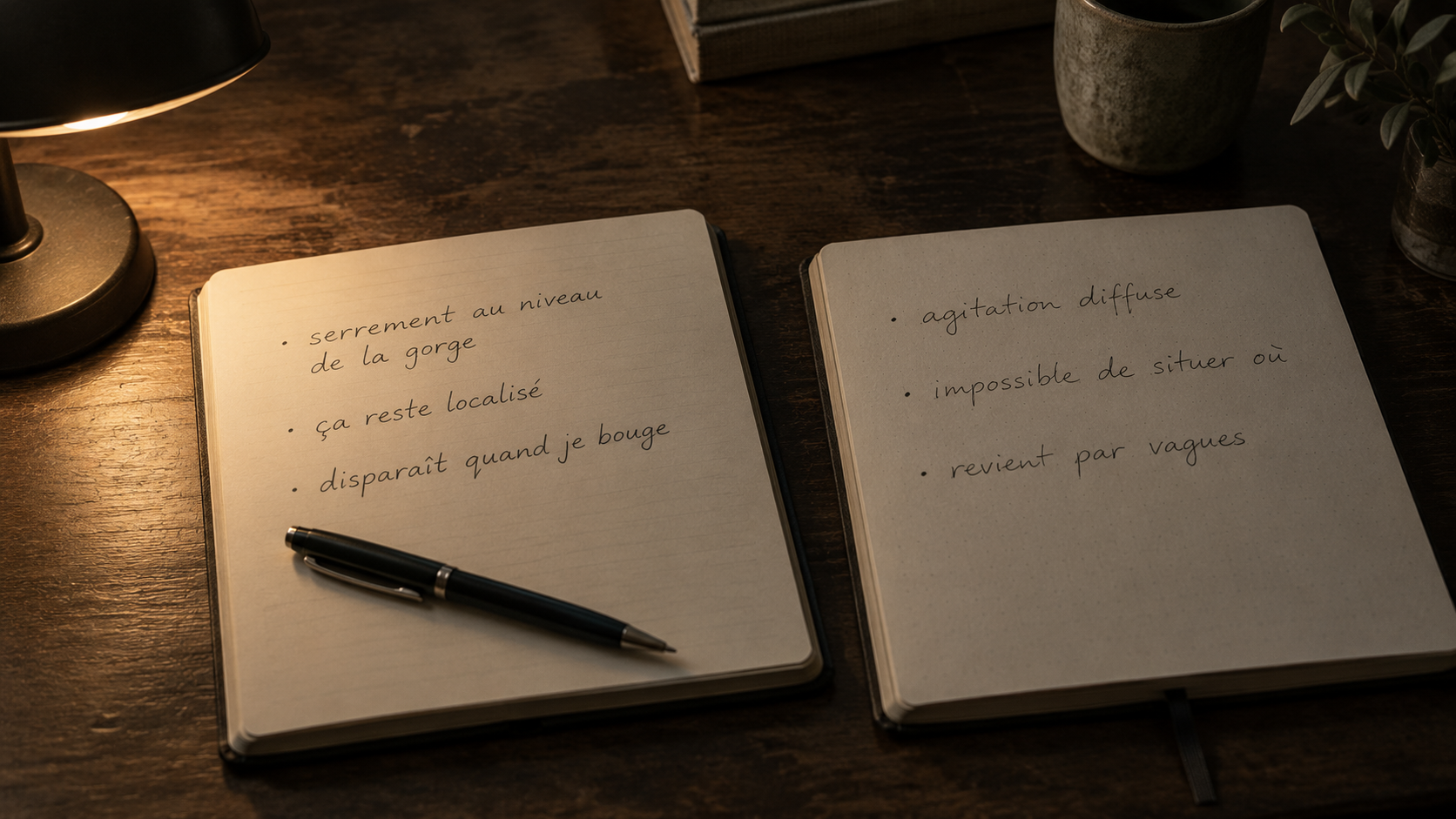
Inner observation is reputed to be solitary. In practice it is, yet the Laboratory has regularly set side by side observations carried out separately on comparable situations. The result is consistent: two observers do not report the same thing, and the gap proves more instructive than the agreement.
What the gap contains
Facing the same constraint, one describes a localised tension, another an acceleration of mental rhythm, a third a narrowing of the field of attention. These descriptions do not contradict one another: they address different layers of a single movement.
What the gap reveals is therefore not the inaccuracy of one or the other, but the position from which each is looking. An observer accustomed to the body sees the body first; one accustomed to thought sees thought first. The habit of observation orients what becomes visible.
This bias cannot be corrected by will. An observer aware of their own tendency does not thereby begin to perceive what they were not perceiving: they simply notice, afterwards, that they have once again described what they usually describe.
A correction solitude does not allow
Working alone exposes one to a simple difficulty: you cannot distinguish what you observe from what you are in the habit of observing. Nothing in the experience itself signals the blind spot.
Being confronted with a description from elsewhere fills that role. Not to establish who is right, which would make no sense here, but to make perceptible what one’s own way of looking systematically leaves aside.
The Laboratory has tested a useful variant: asking two observers to describe the same situation without consulting each other, then to exchange only the descriptions, never the interpretations. The instruction sounds formal. It nonetheless changes the outcome markedly, because it prevents one from adopting the other’s framework before having finished looking.
What disagreement does not mean
A precaution became necessary after several unproductive comparisons. An apparent disagreement between two descriptions does not always indicate a divergence of observation. Very often it indicates a divergence of vocabulary.
Two observers using the word tension may designate, one a localised and stable tightening, the other a diffuse and mobile agitation. The disagreement then bears on words, and discussing it as though it bore on facts wastes time and produces false conclusions.
The remedy is simple but costly in time: before comparing, each describes what they mean by the terms they use. This preliminary doubles the length of the exchange and prevents almost all misunderstandings.
A particular case: being observed by a third party
One variant deserves mention, because it produces data of a different kind. It consists in gathering someone else’s description of your state at the moment you are describing it yourself.
The gaps there are far wider than between two observers describing their own experience. What one perceives of oneself and what is perceptible from outside overlap only partially, and the area of non-overlap is instructive in both directions.
The Laboratory uses this arrangement cautiously, for a substantive reason: it invites confusion between an observation and a judgement. A third party describing a state also describes, inevitably, what that state does to them. The rule adopted is to keep to observable elements, gestures, speech rate, posture, and to set aside any interpretation of what they might mean.
A condition of method
This pooling works on one condition only: describe before interpreting. As soon as observations are phrased as conclusions, they cease to be comparable and become positions to defend.
The Laboratory therefore holds to a strict rule. One reports what was observed, in terms as close as possible to the observation, and refrains from concluding while the material remains insufficient. It is a modest discipline, and it is probably what distinguishes an exploration from a conviction.
One reservation must accompany all this. Such pooling remains infrequent and is carried out among people already familiar with the approach, which sharply limits the scope of the finding. It indicates a direction of work, not a result. The same gap was noted in The Observer Effect.